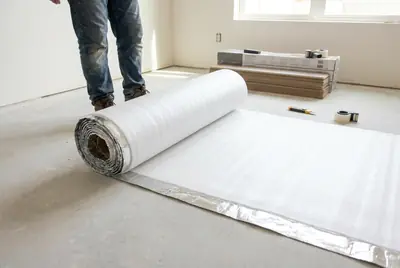
01
Underlayment and vapor film
The quiet half of a quiet floor: foam or fiber underlay with taped seams, plus a moisture film wherever concrete sits below.

Anywhere in Appomattox County, the same routine holds: subfloor checked, underlay rolled, rows clicked straight, trim closed, all at one written square-foot rate.
Measured square-foot quote, free, answered within one business day.
Moving into a new home often means you want to change the floors right away. Picking the right synthetic surface makes your life much easier when it comes to daily cleaning and maintenance.
Choosing the right material for your rooms is a big deal for your budget. You want something that holds up against heavy foot traffic and spills without breaking the bank. These synthetic boards provide a great look that mimics real wood grain while being way more durable than natural timber ever could be.
Because these planks snap together, you save a ton of time during the actual labor process. This means your project gets finished fast so you can return to your normal life. You do not have to worry about long wait times for staining or sealing as you would with traditional hardwood options.
Thinking about the long term is vital for any homeowner looking to increase property value. These surfaces resist scratches from pet claws and heavy furniture much better than softer materials. Which means your investment stays looking fresh for many years without requiring constant upkeep or expensive refinishing services.
Getting everything prepped is the most important step before any material hits the floor. You must ensure the subfloor is perfectly flat so the new planks do not shift or make annoying creaking sounds later. A solid base provides the structural support that every good floor needs to last.
Measuring the space accurately prevents you from wasting expensive materials during the cut phase. You want to account for the weird corners and door frames that usually exist in older houses. By planning ahead, you ensure that every board fits snugly into place for a seamless final result.
Once the surface is ready, the actual laying of the material happens quite quickly. Professionals use specialized tools to tap the planks together until you hear that satisfying click. This locking system keeps the boards tight so moisture cannot sneak between them and cause damage underneath.
Hiring a professional from your own backyard keeps money within the community. You get the added benefit of someone who knows the specific weather patterns and humidity levels in Appomattox County, Virginia. This local knowledge helps them choose the right underlayment to prevent mold or swelling issues throughout the changing seasons.
Asking for a free estimate allows you to see exactly what you are paying for upfront. You avoid hidden fees that often pop up when you try to do the job yourself. When someone comes to your house to measure, they can spot potential problems that you might have completely missed.
You deserve a space that reflects your personality and handles your busy lifestyle. Whether you prefer a dark rustic look or a bright modern aesthetic, there is a design for you. Changing the ground beneath your feet truly transforms the entire feel of your living area into a sanctuary of high satisfaction.
| Feature | Laminate | Traditional Wood | Tile | |
|---|---|---|---|---|
| Durability | Very High | Medium | High | |
| Cost | Budget Friendly | Expensive | Moderate | |
| Installation | Fast | Slow | Slow | |
| Maintenance | Simple | High | Moderate |
Considering the data above shows why so many folks choose this specific path for their home renovations. You get the high-end appearance of natural materials without the massive price tag or the headache of constant care. It is a win for your wallet and your weekend schedule.
Selecting the right thickness is a big decision that impacts how the floor feels under your feet. Thicker planks often provide better sound dampening which is great if you have kids or noisy pets running around. You want a product that feels solid rather than hollow when you walk across the room.
Checking the wear layer rating is also super important for high traffic areas like hallways or kitchens. A higher rating means the surface will resist fading and wearing down even if you host lots of parties. You should always look for a finish that protects against dents and impacts from dropped items.
Installing the trim or baseboards afterwards adds that final touch of refinement to the room. These small details hide the expansion gaps that are necessary for the planks to shift slightly with temperature changes. Without these gaps, your floor might buckle or bubble up when the weather gets warm outside.
Sometimes your subfloor might be uneven or damaged from past water leaks. You might need to add a leveling compound or patch certain spots before you can lay any new material. Addressing these issues early prevents much bigger headaches down the road.
Managing the transition between different types of flooring requires a bit of skill. You want the shift from your bedroom carpet to the new hard surface to look smooth and intentional. Using transition strips creates a clean boundary that keeps your toes from catching on an edge.
Living in a place with a median household income that varies means you appreciate getting the most for your money. You can achieve a look that radiates sheer comfort by choosing the right style and shade. Everyone who visits your home will be impressed by the upgrade without knowing how little you actually spent.
Clearing out the furniture is the first step you should take to help the contractors work efficiently. You can move small items into another room, but heavy pieces might need some extra help. Providing a clear path helps the job go faster and lowers the chance of accidental damage.
Keeping your pets in a safe area during the install is a smart move for everyone involved. The noise from power saws and hammers can be a bit overwhelming for dogs or cats. Once the work is done and the dust settles, your furry friends will love the new surface just as much as you do.
Choosing to update your home is a major decision that brings a lot of excitement. You get to reimagine how your house looks and feels on a daily basis. With the right team handling the heavy lifting, you can just sit back and watch the magic happen.
Getting a quote is the fastest way to turn your ideas into a real project plan. You get a clear breakdown of the labor and material costs involved. This transparency helps you manage your finances and ensures there are no surprises when the final bill arrives at your door.
Searching for a local contractor allows you to build a relationship with someone who cares about the quality of their work. You want someone who treats your home with respect and cleans up after themselves. Finding a pro who values your time makes the whole experience much more pleasant.
The area is beautiful, and your home should match the quality of the surroundings. By investing in your floors, you contribute to the overall appeal of the region. Whether your ZIP code is rural or closer to town, a new floor makes a world of difference.
Now that you know more about how this process works, you can make an informed choice. You do not have to settle for old, worn-out carpets or damaged surfaces any longer. Take the first step toward a refreshed home by reaching out to a professional for your free estimate.
You will love the ease of cleaning and the way the light reflects off your new floors. Every morning starts better when you step onto a surface that you personally selected for your space. It is time to stop dreaming about changes and start making them happen for yourself.
Remember that the right choice is one that balances your budget with your desire for a beautiful living space. You deserve to enjoy your home to the fullest extent every single day. Contact a local pro today to get the process rolling and see your vision come to life.
Every laminate plank carries an abrasion class. It says more about how the floor will age than the photo on the box does, so we quote with it, not around it.
| Rating | Where it belongs | What it takes in stride |
|---|---|---|
| AC3 | Bedrooms, closets, home offices with a chair mat | Everyday footsteps, furniture on felt pads, the vacuum on Sundays |
| AC4 | Living rooms, kitchens, hallways, stair landings | Kids, dogs, dropped keys, the daily route between couch and fridge |
| AC5 | Entryways, home businesses, rentals, busy stairs | Grit walked in from outside, rolling office chairs, tenants you never meet |
AC1 and AC2 exist too; we simply do not lay them, because the savings at the register come back as dull traffic lanes within a couple of years.
We install laminate all day, and it is still not the answer to every room. Here is the comparison we walk through at the kitchen table, with nothing rounded in our favor.
| Laminate | Vinyl plank | |
|---|---|---|
| Water | Modern boards shrug off spills that get wiped up; standing water at a leaky dishwasher is still its weak spot. | Fully waterproof through the core, which is why laundry rooms and full bathrooms lean vinyl. |
| Comfort and sound | Stiffer core, more solid underfoot, and quieter than its reputation once a proper underlay goes in. | Softer and warmer to bare feet, but thin planks telegraph every dip in the subfloor. |
| Price | More floor per dollar at the same thickness, and the realistic wood looks start cheaper. | Comparable at the low end; the rigid-core boards worth owning cost noticeably more. |
| Repair | A click-lock plank can be swapped; keep one spare box in the garage and a scratch is an afternoon fix. | Glued-down planks mean solvent and patience; click vinyl swaps much like laminate does. |
If your project reads vinyl after that table, we will say so during the measure and you keep the comparison for free.
01
The quiet half of a quiet floor: foam or fiber underlay with taped seams, plus a moisture film wherever concrete sits below.
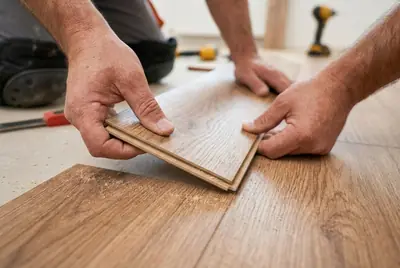
02
Planks angled, clicked and tapped home with staggered joints, so the sight line down the room stays dead straight.
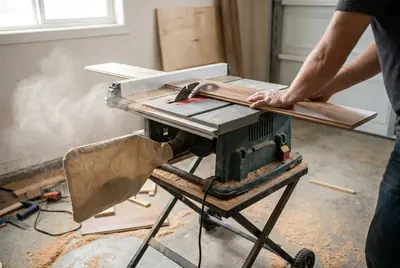
03
Door casings undercut so boards slide beneath, pipes ringed with collars, last rows ripped to width instead of forced.
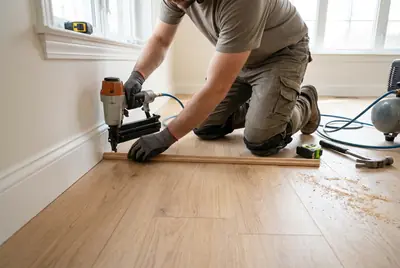
04
The expansion gap disappears behind clean trim, mitered at the corners and caulked where the wall waves.
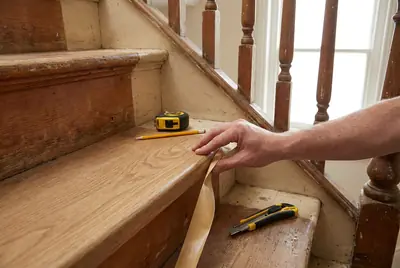
05
Tread and riser kits with proper nosing, glued and screwed, because a stair takes more abuse than any floor below it.
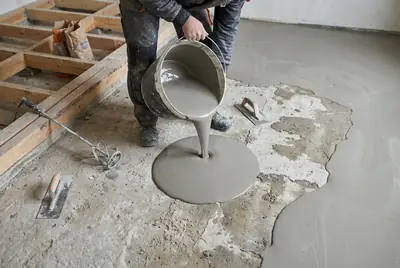
06
Grinding the high spots and pouring self-leveler into the low ones before a single plank leaves its box.
Laminate floats. It is not nailed and not glued, which is exactly why it goes down fast, and exactly why it copies every flaw underneath. A hollow click under your heel, a seam that opens by the window, a plank that rocks by the couch: nine times out of ten the story started below the boards.
So the level comes out before the saw does. We check flatness against the 3/16 inch in 10 feet rule, grind ridges, fill dips with self-leveling compound and let it cure. The underlay then earns its keep twice over, softening footfall sound for the room below and evening out what the compound did not catch.
The last quiet detail is the gap you will never see. Laminate grows and shrinks with the seasons, so every wall, pipe and doorway keeps a small expansion space, and long open stretches get a transition profile. Skip those and summer humidity will fold a hallway into a tent; leave them and the floor stays flat for decades. They are in every quote we write, not on the options list.
A fitter walks the rooms with a laser measure, checks the subfloor and leaves you a square-foot price on paper. No estimate ranges that grow later.
The planks acclimate in the rooms for about 48 hours while we pull the old covering and level whatever the laser flagged.
Underlay, film, then row after row, clicked tight and cut clean at every casing. Most single floors go down between breakfast and dinner.
Baseboards, thresholds, a vacuum pass and a walk through every room together. You keep the leftover planks for future repairs.
| Line item | Usual range | What sits inside it |
|---|---|---|
| Laminate installation, per sqft | $2.50 - $4.50 | Labor for click-lock laying with standard underlay included. |
| Old floor removal, per sqft | $0.60 - $1.50 | Carpet pulls out cheap; glued wood and tile sit at the top end. |
| Subfloor leveling, per sqft treated | $1.00 - $3.00 | Only the flagged low spots pay, never the whole room. |
| Stairs, per step | $45 - $95 | Tread, riser and nosing, fitted, glued and screwed. |
| Baseboard and quarter round, per linear foot | $2.00 - $4.00 | Supplied primed or color-matched to the boards. |
| Small-job minimum | $350 | Keeps a single hallway or one bedroom fair for both sides. |
The planks themselves ride on top of these figures and depend on the board you fall for; the written quote lists them on their own line, so you can swap styles without redoing the math.
Bedrooms, living rooms, hallways and home offices are laminate country, no caveats: warm looks, an AC rating matched to the traffic and a surface that forgives chair legs and dog claws better than the veneer floors it imitates.
Kitchens work well with a water-resistant board, sealed edges and a mat where the sink drips. Full bathrooms are the one room where we tap the brakes: daily steam and puddled water shorten any laminate's life, and we would rather point you to a different surface there than sell you a floor with a countdown on it. Powder rooms, with no tub in sight, are fine.
The moment the last plank clicks. A floating floor needs no glue to cure, so the couch returns the same evening and the bedroom sleeps in its own bed that night. Heavy aquariums and pianos get felt pads and a second pair of hands, not a waiting period.
Planks leave a cold warehouse and arrive in your heated rooms. Two days of acclimating lets them finish their expanding before they are locked together, instead of after, which is how gaps and peaks are born.
Usually, and it saves the demolition line on the quote. The grout lines disappear under the underlay if the tile is flat and sound. Over carpet the answer is always no; the padding flexes and the locks work themselves open.
We work room by room, shifting pieces to the finished side as the floor advances, so nobody rents a storage unit for a two-day job. Emptying closets and small breakables ahead of us is the one favor we ask.
No. A flat subfloor with an 8 mm AC4 board outlives a wavy one with 12 mm every time. Thickness buys sound and feel; the AC rating buys longevity; the leveling buys both. We spend your budget in that order.
You hand us the spare box we left behind. A click-lock floor unzips to the wounded plank and closes again, and a repair like that is an afternoon, not a renovation.
Terrain up here, coverage down there: every community a fitter reaches from this base is linked further down the page.
Somewhere under that carpet is a flat, quiet floor waiting to happen.
Price my floor