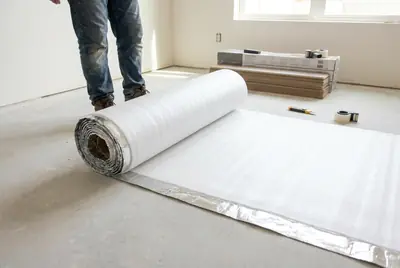
01
Underlayment and vapor film
The quiet half of a quiet floor: foam or fiber underlay with taped seams, plus a moisture film wherever concrete sits below.

Our Indian Island fitters level, lay and trim click-lock laminate across Cowlitz County, and the square-foot price is on paper before the first box opens.
Measured square-foot quote, free, answered within one business day.
Are you tired of staring at ugly carpets in your home? Luckily, laying down new synthetic boards lets you upgrade your space without breaking the bank.
Living right out here in this tiny Washington community brings unique challenges for your home projects. Fortunately, getting a free estimate helps you plan your budget without any guesswork.
Maybe you wonder if plastic-topped wood materials can handle daily foot traffic. Actually, modern manufacturing techniques create remarkably tough surfaces that resist scratches and heavy impacts.
Through this smart design, your rooms stay protected against spills and rough treatment from pets. Consequently, cleaning up messy accidents takes only a quick wipe with a damp mop.
Beneath the pretty photographic top layer sits a high-density fiberboard core that adds serious muscle. This sturdy foundation prevents bending when heavy furniture sits on top of your walking surface.
Right underneath that lies a balancing backing film that blocks moisture from creeping up from the subfloor. Therefore, your planks stay flat and stable through changing seasonal humidity levels.
Instead of messy glues, modern floating floorboards snap together tightly using clever tongue-and-groove milling profiles. Because of this mechanical connection, the installation process moves along much faster than older methods.
Furthermore, individual damaged planks can get swapped out later if something terrible happens to them. This clever trick saves you from ripping up the whole room just to fix one spot.
Before laying down any decorative planks, your wooden or concrete base needs careful inspection. If dips or bumps exist underneath, the finished walking surface might feel spongy or bouncy.
By using self-leveling compounds, local pros smooth out every single imperfection in the foundation. Ultimately, this hard work guarantees your finished floor feels solid underfoot for decades.
Out here in our quiet neck of the woods, finding reliable tradespeople can sometimes feel tricky. With a tiny population of just forty-four residents, local options are naturally quite limited.
Despite our small size, homeowners here still deserve top-tier craftsmanship for every remodeling job. That is why bringing in experienced professionals makes all the difference in your final results.
Many folks wonder how synthetic wood stacks up against traditional hardwood or ceramic tiles. Let us look at a quick breakdown to help you decide.
| Material type | Average cost | Water resistance | Installation speed |
|---|---|---|---|
| Synthetic planks | Budget-friendly | High | Fast |
| Solid hardwood | Expensive | Low | Slow |
| Ceramic tile | Moderate | Maximum | Very slow |
Following this comparison, synthetic options clearly win for everyday family convenience and affordability. Naturally, you still want to pick a style that matches your personal interior design taste.
Every single house has weird corners, tight hallways, and awkward door frames that test your patience. Fortunately, skilled installers use specialized saws to cut boards around every single obstacle.
Through careful measuring, gaps near baseboards disappear completely beneath stylish quarter-round molding pieces. Thus, your upgraded rooms achieve a polished look that rivals high-end custom homes.
Pacific Northwest weather brings plenty of rain and damp air into our living spaces. Without a proper vapor barrier, trapped moisture might warp your brand-new walking surfaces over time.
Placing thick plastic sheeting down first protects your investment from underground humidity issues. Consequently, your floorboards remain completely stable through the wettest winter storms.
Footsteps on hard surfaces can echo loudly through hallways and disturb sleeping family members. Luckily, placing high-density acoustic underlayment beneath your planks absorbs most of that sound.
By dampening those noisy footfalls, your entire living environment feels much quieter and calmer. Therefore, you can walk around in heavy shoes without driving everyone else crazy.
Keeping your new surfaces looking pristine requires almost zero complicated chemical cleaners or polishes. Sweeping away loose dirt regularly prevents microscopic grit from scratching the protective wear layer.
Whenever sticky messes happen, a simple mixture of warm water and mild soap does the trick. Hence, your floors keep their gorgeous sheen without demanding hours of exhausting labor.
Finding someone willing to travel out to our ZIP codes 98626, 98632, or 98683 can test your patience. Many big city companies simply refuse to cross county lines for residential projects.
Working with nearby professionals ensures you get prompt service without paying ridiculous travel fees. On top of that, local contractors understand regional building quirks and weather patterns.
Watching online video tutorials makes laying down planks look deceptively simple and quick. However, minor mistakes during layout planning lead to crooked rows and wasted materials.
Hiring seasoned experts eliminates those costly errors and gets the job done right the first time. Moreover, professional work typically comes with solid warranties that protect your investment.
Ready to transform your drab interior spaces into something truly stunning and modern? Getting started takes only a minute of your time today.
Simply reach out and request your no-cost consultation to discuss your specific project needs. Afterward, a friendly local pro will evaluate your rooms and provide an honest price quote.
Every laminate plank carries an abrasion class. It says more about how the floor will age than the photo on the box does, so we quote with it, not around it.
| Rating | Where it belongs | What it takes in stride |
|---|---|---|
| AC3 | Bedrooms, closets, home offices with a chair mat | Everyday footsteps, furniture on felt pads, the vacuum on Sundays |
| AC4 | Living rooms, kitchens, hallways, stair landings | Kids, dogs, dropped keys, the daily route between couch and fridge |
| AC5 | Entryways, home businesses, rentals, busy stairs | Grit walked in from outside, rolling office chairs, tenants you never meet |
AC1 and AC2 exist too; we simply do not lay them, because the savings at the register come back as dull traffic lanes within a couple of years.
We install laminate all day, and it is still not the answer to every room. Here is the comparison we walk through at the kitchen table, with nothing rounded in our favor.
| Laminate | Vinyl plank | |
|---|---|---|
| Water | Modern boards shrug off spills that get wiped up; standing water at a leaky dishwasher is still its weak spot. | Fully waterproof through the core, which is why laundry rooms and full bathrooms lean vinyl. |
| Comfort and sound | Stiffer core, more solid underfoot, and quieter than its reputation once a proper underlay goes in. | Softer and warmer to bare feet, but thin planks telegraph every dip in the subfloor. |
| Price | More floor per dollar at the same thickness, and the realistic wood looks start cheaper. | Comparable at the low end; the rigid-core boards worth owning cost noticeably more. |
| Repair | A click-lock plank can be swapped; keep one spare box in the garage and a scratch is an afternoon fix. | Glued-down planks mean solvent and patience; click vinyl swaps much like laminate does. |
If your project reads vinyl after that table, we will say so during the measure and you keep the comparison for free.
01
The quiet half of a quiet floor: foam or fiber underlay with taped seams, plus a moisture film wherever concrete sits below.
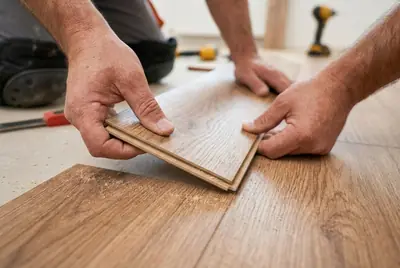
02
Planks angled, clicked and tapped home with staggered joints, so the sight line down the room stays dead straight.
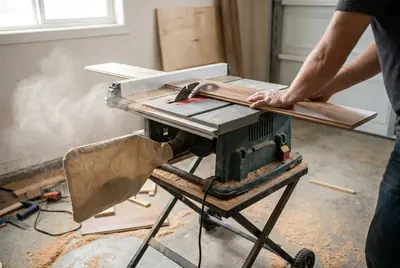
03
Door casings undercut so boards slide beneath, pipes ringed with collars, last rows ripped to width instead of forced.
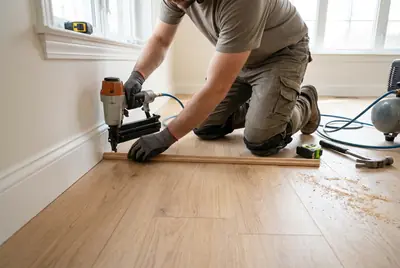
04
The expansion gap disappears behind clean trim, mitered at the corners and caulked where the wall waves.
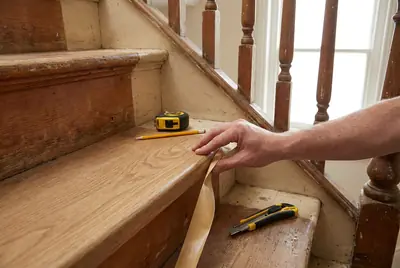
05
Tread and riser kits with proper nosing, glued and screwed, because a stair takes more abuse than any floor below it.
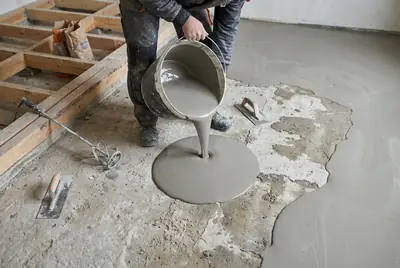
06
Grinding the high spots and pouring self-leveler into the low ones before a single plank leaves its box.
Laminate floats. It is not nailed and not glued, which is exactly why it goes down fast, and exactly why it copies every flaw underneath. A hollow click under your heel, a seam that opens by the window, a plank that rocks by the couch: nine times out of ten the story started below the boards.
So the level comes out before the saw does. We check flatness against the 3/16 inch in 10 feet rule, grind ridges, fill dips with self-leveling compound and let it cure. The underlay then earns its keep twice over, softening footfall sound for the room below and evening out what the compound did not catch.
The last quiet detail is the gap you will never see. Laminate grows and shrinks with the seasons, so every wall, pipe and doorway keeps a small expansion space, and long open stretches get a transition profile. Skip those and summer humidity will fold a hallway into a tent; leave them and the floor stays flat for decades. They are in every quote we write, not on the options list.
A fitter walks the rooms with a laser measure, checks the subfloor and leaves you a square-foot price on paper. No estimate ranges that grow later.
The planks acclimate in the rooms for about 48 hours while we pull the old covering and level whatever the laser flagged.
Underlay, film, then row after row, clicked tight and cut clean at every casing. Most single floors go down between breakfast and dinner.
Baseboards, thresholds, a vacuum pass and a walk through every room together. You keep the leftover planks for future repairs.
| Line item | Usual range | What sits inside it |
|---|---|---|
| Laminate installation, per sqft | $2.50 - $4.50 | Labor for click-lock laying with standard underlay included. |
| Old floor removal, per sqft | $0.60 - $1.50 | Carpet pulls out cheap; glued wood and tile sit at the top end. |
| Subfloor leveling, per sqft treated | $1.00 - $3.00 | Only the flagged low spots pay, never the whole room. |
| Stairs, per step | $45 - $95 | Tread, riser and nosing, fitted, glued and screwed. |
| Baseboard and quarter round, per linear foot | $2.00 - $4.00 | Supplied primed or color-matched to the boards. |
| Small-job minimum | $350 | Keeps a single hallway or one bedroom fair for both sides. |
The planks themselves ride on top of these figures and depend on the board you fall for; the written quote lists them on their own line, so you can swap styles without redoing the math.
Bedrooms, living rooms, hallways and home offices are laminate country, no caveats: warm looks, an AC rating matched to the traffic and a surface that forgives chair legs and dog claws better than the veneer floors it imitates.
Kitchens work well with a water-resistant board, sealed edges and a mat where the sink drips. Full bathrooms are the one room where we tap the brakes: daily steam and puddled water shorten any laminate's life, and we would rather point you to a different surface there than sell you a floor with a countdown on it. Powder rooms, with no tub in sight, are fine.
The moment the last plank clicks. A floating floor needs no glue to cure, so the couch returns the same evening and the bedroom sleeps in its own bed that night. Heavy aquariums and pianos get felt pads and a second pair of hands, not a waiting period.
Planks leave a cold warehouse and arrive in your heated rooms around Indian Island. Two days of acclimating lets them finish their expanding before they are locked together, instead of after, which is how gaps and peaks are born.
Usually, and it saves the demolition line on the quote. The grout lines disappear under the underlay if the tile is flat and sound. Over carpet the answer is always no; the padding flexes and the locks work themselves open.
We work room by room, shifting pieces to the finished side as the floor advances, so nobody rents a storage unit for a two-day job. Emptying closets and small breakables ahead of us is the one favor we ask.
No. A flat subfloor with an 8 mm AC4 board outlives a wavy one with 12 mm every time. Thickness buys sound and feel; the AC rating buys longevity; the leveling buys both. We spend your budget in that order.
You hand us the spare box we left behind. A click-lock floor unzips to the wounded plank and closes again, and a repair like that is an afternoon, not a renovation.
Terrain up here, coverage down there: every community a fitter reaches from this base is linked further down the page.
Somewhere under that carpet is a flat, quiet floor waiting to happen.
Price my floor