01
Underlayment and vapor film
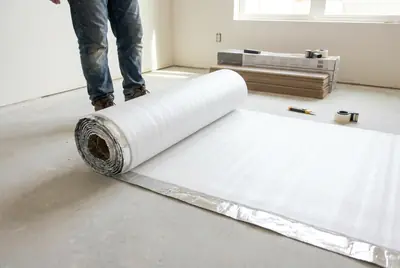
The quiet half of a quiet floor: foam or fiber underlay with taped seams, plus a moisture film wherever concrete sits below.

Our Woodmere fitters level, lay and trim click-lock laminate across Nassau County, and the square-foot price is on paper before the first box opens.
Measured square-foot quote, free, answered within one business day.
Perhaps you want to update your tired old rooms right now. This smart home upgrade gives you stunning visuals while keeping your wallet happy. Let us help you transform your living spaces today.
Many homeowners love how durable these synthetic boards really are. Wood planks scratch easily under heavy traffic or playful pets. Meanwhile, modern laminate withstands daily abuse without breaking a sweat. Which means you can enjoy beautiful surfaces without constantly worrying about damage.
Furthermore, cleaning up spills takes just a quick swipe with a damp cloth. Muddy boots or dropped juice boxes will not ruin your weekend. This lets you relax and spend more time enjoying your home instead of cleaning it.
Additionally, budget constraints often stop remodeling projects dead in their tracks. Real hardwood costs an arm and a leg to purchase and lay down. However, this affordable alternative mimics exotic timber species at a fraction of the price tag.
Living in this charming Nassau County town means you appreciate good value. Local properties feature unique architectural styles ranging from split levels to colonial houses. Upgrading your interior surfaces makes your home pop during neighborhood gatherings.
Consider the demographic profile of your area where the population sits around 17467 residents. With a solid median household income of $128889 families invest heavily in their properties. Boosting your interior aesthetic directly increases your overall property value down the road.
Postal carriers deliver mail daily across ZIP codes 11598 to eager homeowners just like you. Local contractors know the specific building styles prevalent throughout this region very well. Therefore you get tailored service matching your exact neighborhood aesthetic.
First off, a professional crew arrives at your doorstep to inspect the subfloor thoroughly. Uneven concrete or warped plywood can ruin even the best materials over time. Fixing these issues beforehand ensures your boards stay flat and quiet for decades.
Next comes the crucial acclimation phase where boxes sit inside your rooms for days. Wood-based products expand and contract depending on indoor humidity levels. Allowing them to adjust prevents unsightly buckling once everything is locked into place.
Following that preparation, technicians snap the interlocking planks together over a protective foam underlayment. This floating floor method requires no messy glues or heavy nails. Consequently, the crew finishes most standard rooms in just a single day.
Homeowners often wonder how synthetic wood boards stack up against other options. Let us break down the differences so you can make an informed choice. Review this handy comparison chart before making your final decision.
| Material Type | Average Cost | Durability | Water Resistance |
|---|---|---|---|
| Solid Hardwood | High | Medium | Low |
| Synthetic Planks | Low | High | Medium to High |
| Wall-to-Wall Carpet | Medium | Low | Very Low |
Naturally, each material brings distinct pros and cons to your specific living situation. Hardwood looks authentic but demands meticulous maintenance and constant refinishing work. Carpeting feels plush initially yet traps dust mites and stubborn pet odors permanently.
Conversely, multi-layer composite planks resist fading even under harsh sunlight streaming through windows. This lets you place heavy furniture anywhere without fearing permanent indentations or surface cracks. Ultimately, you get a resilient surface that handles chaotic family life effortlessly.
Many DIY enthusiasts try tackling this complex trade project over a frantic weekend. Unfortunately, improper expansion gaps cause the entire floor to warp and heave upward. Hiring skilled local professionals eliminates these costly rookie mistakes right from the start.
Another frequent error involves skipping the moisture barrier underneath ground-level rooms. Excess humidity from concrete slabs ruins organic core layers surprisingly fast. Experienced installers always test moisture levels before laying down a single board.
Equally important is cutting door jambs correctly to let planks slide underneath smoothly. Amateurs often hack jagged holes around frames resulting in sloppy unfinished edges. True craftsmen use specialized saws to guarantee a clean flush appearance everywhere.
Keeping your new walking surfaces pristine requires very little effort on your part. Avoid soaking the floor with heavy amounts of water during weekly cleaning routines. Instead, use a dry microfiber mop to trap dust bunnies and loose debris.
Protective felt pads under heavy couch legs prevent unexpected scratches during room rearrangements. Small preventive habits preserve the factory finish for many wonderful years ahead. Which means your investment keeps paying visual dividends long after the installation ends.
Pets require trimmed nails to avoid leaving faint scuff marks on high-traffic pathways. While tough wear layers protect against most daily abuse, sharp claws still push limits. Being mindful of these details ensures your rooms look brand new indefinitely.
Ready to turn your outdated interior into a modern masterpiece today? Reach out now to request your absolutely free quote from local pros. Look for transparent pricing with zero hidden fees or surprise charges.
Send in a request or fill out the quick online booking form right now. Our friendly team looks forward to discussing your upcoming home improvement goals. Let us help you create the stunning living space you truly deserve.
Every laminate plank carries an abrasion class. It says more about how the floor will age than the photo on the box does, so we quote with it, not around it.
| Rating | Where it belongs | What it takes in stride |
|---|---|---|
| AC3 | Bedrooms, closets, home offices with a chair mat | Everyday footsteps, furniture on felt pads, the vacuum on Sundays |
| AC4 | Living rooms, kitchens, hallways, stair landings | Kids, dogs, dropped keys, the daily route between couch and fridge |
| AC5 | Entryways, home businesses, rentals, busy stairs | Grit walked in from outside, rolling office chairs, tenants you never meet |
AC1 and AC2 exist too; we simply do not lay them, because the savings at the register come back as dull traffic lanes within a couple of years.
We install laminate all day, and it is still not the answer to every room. Here is the comparison we walk through at the kitchen table, with nothing rounded in our favor.
| Laminate | Vinyl plank | |
|---|---|---|
| Water | Modern boards shrug off spills that get wiped up; standing water at a leaky dishwasher is still its weak spot. | Fully waterproof through the core, which is why laundry rooms and full bathrooms lean vinyl. |
| Comfort and sound | Stiffer core, more solid underfoot, and quieter than its reputation once a proper underlay goes in. | Softer and warmer to bare feet, but thin planks telegraph every dip in the subfloor. |
| Price | More floor per dollar at the same thickness, and the realistic wood looks start cheaper. | Comparable at the low end; the rigid-core boards worth owning cost noticeably more. |
| Repair | A click-lock plank can be swapped; keep one spare box in the garage and a scratch is an afternoon fix. | Glued-down planks mean solvent and patience; click vinyl swaps much like laminate does. |
If your project reads vinyl after that table, we will say so during the measure and you keep the comparison for free.
01
The quiet half of a quiet floor: foam or fiber underlay with taped seams, plus a moisture film wherever concrete sits below.
02
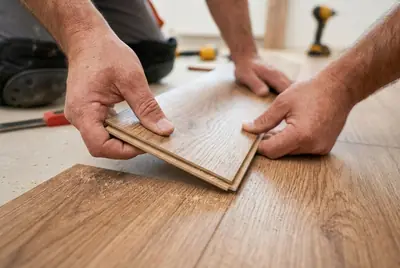
Planks angled, clicked and tapped home with staggered joints, so the sight line down the room stays dead straight.
03
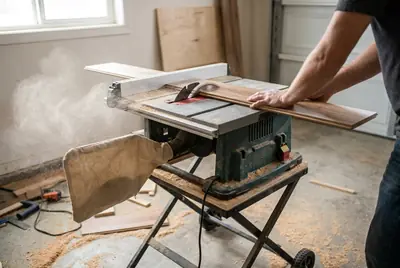
Door casings undercut so boards slide beneath, pipes ringed with collars, last rows ripped to width instead of forced.
04
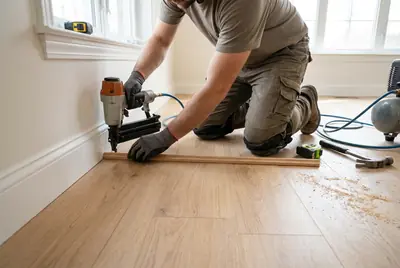
The expansion gap disappears behind clean trim, mitered at the corners and caulked where the wall waves.
05
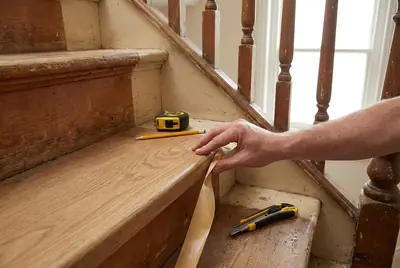
Tread and riser kits with proper nosing, glued and screwed, because a stair takes more abuse than any floor below it.
06
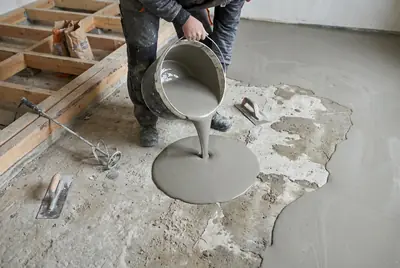
Grinding the high spots and pouring self-leveler into the low ones before a single plank leaves its box.
Laminate floats. It is not nailed and not glued, which is exactly why it goes down fast, and exactly why it copies every flaw underneath. A hollow click under your heel, a seam that opens by the window, a plank that rocks by the couch: nine times out of ten the story started below the boards.
So the level comes out before the saw does. We check flatness against the 3/16 inch in 10 feet rule, grind ridges, fill dips with self-leveling compound and let it cure. The underlay then earns its keep twice over, softening footfall sound for the room below and evening out what the compound did not catch.
The last quiet detail is the gap you will never see. Laminate grows and shrinks with the seasons, so every wall, pipe and doorway keeps a small expansion space, and long open stretches get a transition profile. Skip those and summer humidity will fold a hallway into a tent; leave them and the floor stays flat for decades. They are in every quote we write, not on the options list.
A fitter walks the rooms with a laser measure, checks the subfloor and leaves you a square-foot price on paper. No estimate ranges that grow later.
The planks acclimate in the rooms for about 48 hours while we pull the old covering and level whatever the laser flagged.
Underlay, film, then row after row, clicked tight and cut clean at every casing. Most single floors go down between breakfast and dinner.
Baseboards, thresholds, a vacuum pass and a walk through every room together. You keep the leftover planks for future repairs.
| Line item | Usual range | What sits inside it |
|---|---|---|
| Laminate installation, per sqft | $2.50 - $4.50 | Labor for click-lock laying with standard underlay included. |
| Old floor removal, per sqft | $0.60 - $1.50 | Carpet pulls out cheap; glued wood and tile sit at the top end. |
| Subfloor leveling, per sqft treated | $1.00 - $3.00 | Only the flagged low spots pay, never the whole room. |
| Stairs, per step | $45 - $95 | Tread, riser and nosing, fitted, glued and screwed. |
| Baseboard and quarter round, per linear foot | $2.00 - $4.00 | Supplied primed or color-matched to the boards. |
| Small-job minimum | $350 | Keeps a single hallway or one bedroom fair for both sides. |
The planks themselves ride on top of these figures and depend on the board you fall for; the written quote lists them on their own line, so you can swap styles without redoing the math.
Bedrooms, living rooms, hallways and home offices are laminate country, no caveats: warm looks, an AC rating matched to the traffic and a surface that forgives chair legs and dog claws better than the veneer floors it imitates.
Kitchens work well with a water-resistant board, sealed edges and a mat where the sink drips. Full bathrooms are the one room where we tap the brakes: daily steam and puddled water shorten any laminate's life, and we would rather point you to a different surface there than sell you a floor with a countdown on it. Powder rooms, with no tub in sight, are fine.
The moment the last plank clicks. A floating floor needs no glue to cure, so the couch returns the same evening and the bedroom sleeps in its own bed that night. Heavy aquariums and pianos get felt pads and a second pair of hands, not a waiting period.
Planks leave a cold warehouse and arrive in your heated rooms around Woodmere. Two days of acclimating lets them finish their expanding before they are locked together, instead of after, which is how gaps and peaks are born.
Usually, and it saves the demolition line on the quote. The grout lines disappear under the underlay if the tile is flat and sound. Over carpet the answer is always no; the padding flexes and the locks work themselves open.
We work room by room, shifting pieces to the finished side as the floor advances, so nobody rents a storage unit for a two-day job. Emptying closets and small breakables ahead of us is the one favor we ask.
No. A flat subfloor with an 8 mm AC4 board outlives a wavy one with 12 mm every time. Thickness buys sound and feel; the AC rating buys longevity; the leveling buys both. We spend your budget in that order.
You hand us the spare box we left behind. A click-lock floor unzips to the wounded plank and closes again, and a repair like that is an afternoon, not a renovation.
Terrain up here, coverage down there: every community a fitter reaches from this base is linked further down the page.
Somewhere under that carpet is a flat, quiet floor waiting to happen.
Price my floor